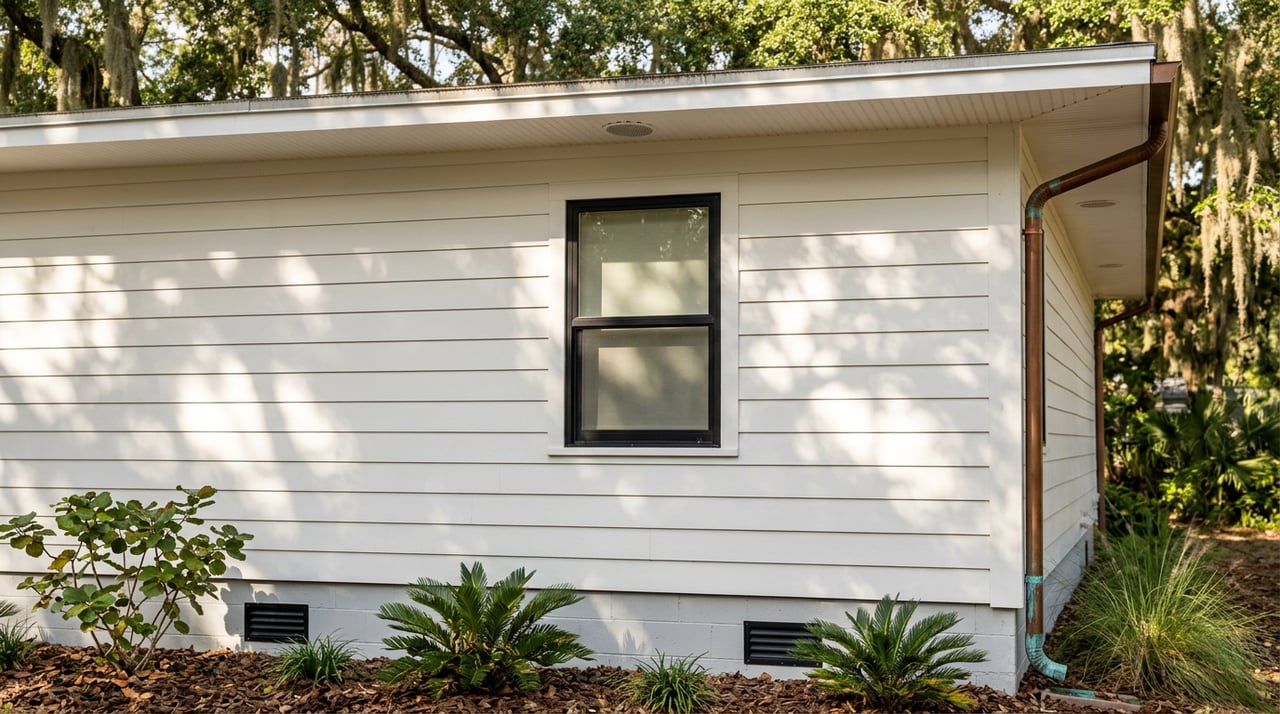
The Renovation Trap: Selling an Older Dunedin Home in a Flood Zone in 2026
July 9, 2026
July 9, 2026
If you own a 1940s bungalow off Douglas Avenue or a mid-century block home along Edgewater Drive, the hardest part of selling in 2026 will not be the disclosure form. It will be the receipts you already have in a drawer.
Pinellas County tracks renovation costs on a rolling twelve-month window when it applies the FEMA 50% rule. That mechanism has been in the code for years, but the combination of an expanded state flood disclosure, tighter insurance underwriting, and a slower Dunedin market means it now surfaces in buyer negotiations in ways it did not eighteen months ago. Sellers who understand the arithmetic before listing keep control of the price. Sellers who don't often lose it at inspection.
The FEMA 50% rule is usually explained as a future problem, something a buyer might worry about if they plan to renovate. In Dunedin, it is often a present problem for the seller, because permits pulled in the last twelve months follow the property into the transaction. A well-meaning kitchen refresh from last spring can compress how much a new owner is allowed to spend before the entire structure must be brought up to current floodplain compliance, which in most cases means elevation. Buyers and their agents have started asking for the permit history first and the granite counters second.
Dunedin has participated in the National Flood Insurance Program since 1971 and carries roughly 3,400 active policies covering about $800 million in structures, per the City of Dunedin's own 50% rule guidance. That is a lot of exposure for a city with a June 2026 median list price around $414K on Movoto and $534,900 on Broker One, and a housing stock where a meaningful share of homes predate the 2002 building code overhaul that followed Hurricane Andrew.
FEMA's rule, codified at 44 CFR §59.1, defines substantial improvement as any reconstruction, rehabilitation, addition, or other improvement whose cost equals or exceeds 50% of the pre-improvement market value of the structure. Land value is excluded. Only the building counts.
Pinellas County calculates the threshold comprehensively. Labor, including the fair market value of owner-performed labor, counts. Materials count. What does not count: finished lot value, survey costs, title fees, and certain federally declared disaster repairs. The county then tracks cumulative permitted work over a rolling twelve-month period.
A worked example makes the friction visible.
| Item | Cost | Running Total | % of Structure Value |
|---|---|---|---|
| Structure value on Pinellas Property Appraiser record | $220,000 | — | — |
| March 2026: bathroom remodel permit | $42,000 | $42,000 | 19% |
| July 2026: kitchen + flooring permit | $58,000 | $100,000 | 45% |
| October 2026: impact window package | $18,000 | $118,000 | 54% |
At the October permit, the rolling twelve-month total crosses the threshold. The county can require the entire structure be brought into current floodplain compliance before that permit is issued. In an AE zone, that generally means elevating the finished floor to base flood elevation plus one foot of freeboard, the Pinellas minimum. In a VE zone along the water, requirements tighten further, with open foundations and breakaway walls below BFE.
If you sold the house in September, the buyer inherits both the running total and the shortened runway. A buyer who wanted to add a primary suite next spring now cannot, at least not without triggering elevation. That constraint gets priced into the offer.
Florida's flood disclosure statute at §689.302 took effect October 1, 2024, then expanded on October 1, 2025 under SB 948 (Chapter 2025-166, Laws of Florida). The revised statute broadens what a seller must reveal in three ways worth reading carefully:
The seller must disclose knowledge of any flooding that damaged the property during ownership, not only flooding that produced an insurance claim. The seller must disclose assistance received to remediate flood damage, not only federal assistance. The disclosure must be delivered as a separate document at or before contract execution.
The practical consequence in Dunedin, where Hurricane Helene pushed storm surge into low-lying blocks along the harbor in 2024, is that many sellers now have something to disclose that they did not think of as a "flood" at the time. A garage that took two inches of water and dried out on its own is disclosable. A neighborhood assistance grant that helped replace a water heater is disclosable. Guidance from the Florida Division of Emergency Management issued in January 2026 also clarified that temporary flood barriers, the kind marketed heavily after 2024, do not satisfy Florida Building Code or NFIP compliance for new construction, substantial improvement, or repair of substantial damage. Sellers who installed them cannot present them as a mitigation feature.
Chapter 2026-63, Laws of Florida (HB 803, 2026) reinforces the point on the permitting side. Nothing about temporary or removable barriers moves a pre-2002 home into current compliance.
Nearly every Florida carrier requires a 4-Point inspection for homes over thirty years old. Wind mitigation is not required, but almost every buyer orders one because the discount it can unlock on premium is significant under NFIP Risk Rating 2.0 and on the private wind side. Without an elevation certificate, insurers default to the highest-rate tier for the zone.
For older Dunedin housing stock, three inspections tend to shape the negotiation:
| Inspection | Typical Dunedin cost | What buyers are actually checking |
|---|---|---|
| 4-Point | around $100 add-on | Roof age, electrical panel brand, plumbing supply and drain material, HVAC condition |
| Wind Mitigation | around $100 add-on | Roof shape, deck attachment, secondary water barrier, opening protection, roof-to-wall connection |
| Sewer Scope | $150 to $250 | Cast iron drain line integrity on any home built before 1975 |
The pattern that catches sellers off guard: a home built in 1962 with original cast iron drains can appraise and inspect cleanly on the standard buyer's inspection, then fail the sewer scope with root intrusion or channeling. Replacement under a concrete slab in Pinellas commonly runs into five figures. That number becomes a repair credit request. Federal Pacific or Zinsco electrical panels, common in 1960s and 1970s Florida homes, trigger a similar conversation on the 4-Point. Insurers frequently will not bind a policy until they are replaced.
A pre-listing 4-Point and wind mitigation run through Mizell Home Inspections turns each of these into a document you hand the buyer, not a surprise they hand you.
Sellers who close on price in this market tend to arrive at listing with a folder, not a story:
If the home is listed on the National Register of Historic Places or carries a local historic designation, a narrow exemption from certain substantial-improvement requirements is available with written approval from the Florida Division of Historic Resources. That path is real but slow and should be explored before listing, not during due diligence.
Dunedin is not the seller's market it was in 2022. Redfin's three-month window ending April 2026 showed a median sale price of $387K, down 9.36% year over year, with homes selling in around 49 days. Movoto reported a June 2026 median list around $414K with a 73-day median time on market. Movoto and Broker One disagree on the June median, which is a signal in itself: mix matters more than the headline. A cleanly documented 1955 block home priced against comparable elevation and permit histories closes. A visually charming bungalow with an unresolved 50% rule question sits.
That is the market condition the folder is built for.
Does an as-is contract remove my disclosure obligation? No. Under Johnson v. Davis, 480 So. 2d 625 (Fla. 1985), a seller must disclose facts materially affecting value that are not readily observable to the buyer. An as-is clause affects who pays for repairs, not what must be disclosed.
Will elevating the home before listing pay back? Sometimes, on waterfront parcels where the land carries most of the value and the market rewards a compliant new build. On interior blocks with mid-market structures, the elevation cost often exceeds the price lift. This is a case-by-case underwriting question, not a general rule.
What if my prior renovation was never permitted? Unpermitted work does not remove the 50% rule exposure, and it creates its own disclosure and lender problem. The path forward is a permit-by-affidavit or retroactive permit through Dunedin Community Development before listing, not after inspection.
If you own an older home in Dunedin and want to know exactly where you sit against the 50% threshold, the disclosure statute, and today's buyer inspection stack before you list, Ocean Breeze Luxury Realty will walk the property with you and pull the records. Get a Free Home Valuation to start.


We pride ourselves in providing personalized solutions that bring our clients closer to their dream properties and enhance their long-term wealth.